"if a bonds required return falls, what will happen to its price?"
Yield is a full general term that relates to the render on the capital you invest in a bond.
At that place are several definitions that are important to understand when talking nigh yield as it relates to bonds: coupon yield, current yield, yield-to-maturity, yield-to-call and yield-to-worst.
Let's start with the basic yield concepts.
- Coupon yield is the almanac interest rate established when the bond is issued. It's the same equally the coupon rate and is the amount of income you collect on a bond, expressed as a percentage of your original investment. If y'all purchase a bail for $1,000 and receive $45 in annual interest payments, your coupon yield is iv.5 percent. This amount is figured equally a percentage of the bond's par value and will not modify during the lifespan of the bond
- Electric current yield is the bond'due south coupon yield divided by its market toll. Here's the math on a bond with a coupon yield of 4.5 percentage trading at 103 ($1,030).
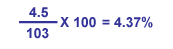
Say y'all check the bail's price later, and information technology's trading at 101 ($1,010). The electric current yield has inverse:
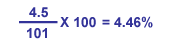
If yous purchase a new bond at par and hold it to maturity, your current yield when the bail matures volition be the same every bit the coupon yield.
Yields That Matter More
Coupon and electric current yield but have y'all and so far down the path of estimating the return your bail volition deliver. For i, they don't measure the value of reinvested involvement. They also aren't much aid if your bond is chosen early—or if yous want to evaluate the lowest yield you can receive from your bail. In these cases, you need to practise some more advanced yield calculations. Fortunately, there is a spate of financial calculators available—some that even judge yield on a before- and afterwards-revenue enhancement basis. The following yields are worth knowing, and should be at your broker's fingertips:
- Yield to maturity (YTM) is the overall involvement rate earned by an investor who buys a bond at the market place price and holds it until maturity. Mathematically, information technology is the discount rate at which the sum of all futurity greenbacks flows (from coupons and principal repayment) equals the cost of the bond. YTM is often quoted in terms of an almanac rate and may differ from the bond's coupon charge per unit. It assumes that coupon and main payments are made on fourth dimension. It does not crave dividends to be reinvested, but computations of YTM by and large make that assumption. Further, information technology does not consider taxes paid past the investor or brokerage costs associated with the purchase.
- Yield to call (YTC) is figured the same way as YTM, except instead of plugging in the number of months until a bond matures, you use a call date and the bail'south telephone call price. This calculation takes into account the impact on a bail's yield if information technology is called prior to maturity and should be performed using the first date on which the issuer could telephone call the bond.
- Yield to worst (YTW) is whichever of a bond's YTM and YTC is lower. If you want to know the most conservative potential return a bond can give you—and you should know information technology for every callable security—then perform this comparison.
- Yield reflecting banker compensation is the yield adapted by the amount of the marker-up or committee (when you purchase) or mark-downwards or commission (when you sell) and other fees or charges that you lot are charged by your broker for its services.
Three Assumptions
YTM and YTC are based on the following assumptions:
- You lot agree your bond to maturity or phone call date.
- You reinvest every coupon.
- All coupons are reinvested at the YTM or YTC, whichever is applicable.
Involvement rates regularly fluctuate, making each reinvestment at the same rate nearly incommunicable. Thus, YTM and YTC are estimates only, and should exist treated as such. While helpful, it's important to realize that YTM and YTC may not be the same as a bail's total render. Such a figure is only accurately computed when you sell a bond or when it matures.
Bond Fact
Cost and yield are inversely related: As the cost of a bond goes up, its yield goes downward, and vice versa.
Reading a Yield Bend
You've probably seen fiscal commentators talk about the Treasury Yield Curve when discussing bonds and interest rates. It's a handy tool because it provides, in one simple graph, the key Treasury bond information points for a given trading twenty-four hours, with involvement rates running upward the vertical axis and maturity running along the horizontal axis.
A typical yield curve is upward sloping, meaning that securities with longer holding periods bear college yield.
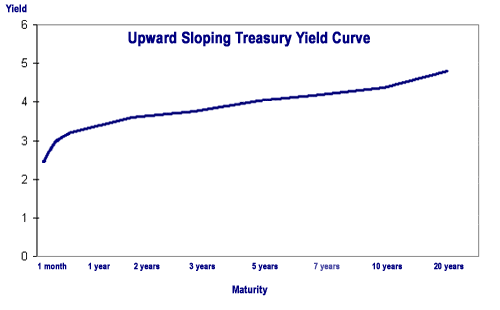
In the yield bend to a higher place, interest rates (and also the yield) increase every bit the maturity or holding menstruation increases—yield on a 30-24-hour interval T-bill is 2.55 percent, compared to iv.lxxx pct for a 20-year Treasury bail—but not by much. When an up-sloping yield bend is relatively flat, it means the difference between an investor's return from a short-term bail and the return from a long-term bond is minimal. Investors would want to weigh the risk of holding a bond for a long flow (see Interest Rate Gamble) versus the merely moderately higher interest rate increase they would receive compared to a shorter-term bail.
Indeed, yield curves tin can exist flatter or steeper depending on economic conditions and what the Federal Reserve Board (or the "Fed") is doing, or what investors expect the Fed to do, with the money supply. Sometimes economic conditions and expectations create a yield curve with different characteristics. For instance, an inverted yield curve slopes downwardly instead of up. When this happens, brusk-term bonds pay more than long-term bonds. Yield curve watchers generally read this as a sign that interest rates may decline.
The Department of Treasury provides daily Treasury Yield Curve rates, which can exist used to plot the yield curve for that day.
Figuring Bond Return
If you've held a bond over a long menstruum of time, you lot might want to calculate its annual pct render, or the percentage return divided by the number of years you've held the investment. For instance, a $1,000 bond held over 3 years with a $145 return has a 14.5 per centum return, but a 4.83 percent annual return.
When yous calculate your return, yous should account for annual aggrandizement. Computing your real rate of render will requite you an thought of the ownership power your earnings will have in a given yr. Y'all tin determine real return past subtracting the aggrandizement rate from your percentage render. As an example, an investment with 5 per centum return during a year of 2 percent aggrandizement is normally said to accept a real return of iii percent.
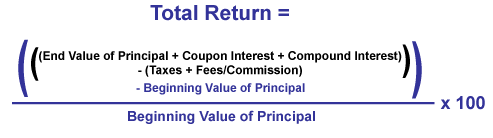
To figure total return, start with the value of the bail at maturity (or when you sold information technology) and add all of your coupon earnings and compounded interest. Subtract from this figure whatsoever taxes and any fees or commissions. So subtract from this amount your original investment amount. This will give you the total amount of your total gain or loss on your bond investment. To figure the return equally a percentage, separate that number by the offset value of your investment and multiply by 100:
Source: https://www.finra.org/investors/learn-to-invest/types-investments/bonds/bond-yield-and-return
0 Response to ""if a bonds required return falls, what will happen to its price?""
Post a Comment